The National Science Foundation has awarded Dr. Kanani Lee, Physics Department, $389,000 to study optical properties of minerals and how they affect temperature measurements under conditions deep inside the Earth.
The temperatures at which minerals melt is influenced by their color, a feature that causes discrepancies in high-pressure melting curves. Melting curves represent the boundary between solid and liquid forms of a material. Errors in these curves can profoundly impact scientific understanding of basic Earth processes.
Lee’s work focuses on two minerals — bridgmanite and ferropericlase – which comprise more than half of Earth’s volume. Her research will lead to more accurate temperature determinations of these and other planetary materials under high pressure and high temperature conditions. This will, in turn, provide scientists with a better understanding of the formation, evolution, and current structure of Earth.
Lee explains the idea in more detail: “Instead of using a thermometer to measure temperatures above a few thousand degrees, we use the glow that emanates from the sample. The brighter the glow, the hotter it is. It’s the same process that astronomers use to determine the surface temperature of a star. “
Interestingly, however, temperature is not just a function of how brightly a star glows but also about the color of the light it emits. Lee offers the Sun as an example: “The Sun’s surface temperature is roughly 6,000 Kelvin (10,000º F), but we don’t feel that high temperature here on Earth. However, we do know that when a cloud goes in front of the Sun, we feel cooler because the cloud blocks some of the rays that reach us. The Sun itself did not change temperature.” As she points out, instead, the brightness of the rays reaching us diminished. “Likewise,” she continues, “when we put on a pair of sunglasses, the Sun’s rays seems dimmer. The Sun itself did not decrease in temperature.” Instead, the color of the light changed.
In addition to temperature corrections for the “color of brightness,” Lee and her team will develop an optical absorption database and a free, user-friendly software toolkit that will help other scientists incorporate the temperature corrections into their own measurements. This crucial step vastly broadens the impact of her research by allowing researchers in any discipline to make more accurate measurements.
To conduct this work, Lee uses diamond-anvil cells to create high-pressure environments like those found in the Earth’s interior but on a much smaller scale. Imagine two small flawless diamonds whose tips have been polished flat and pressed together with the mineral sample between them. The flattened tips, called culets, have a diameter equivalent to the thickness of a single strand of hair.
Applying force to these diamonds yields intense static pressures — more than a million times that of air pressure felt at sea level. Because the diamonds are transparent, Lee can observe how the sample behaves under such intense conditions. She can also observe any color changes that affect temperature measurements.
![Left: An iron-rich enstatite sample at low pressure. Right: The same sample but at a higher pressure. The darkening of the irregular-shaped sample shows how color can change dramatically under pressure. A scale bar is shown. [Photo: Kanani Lee]](https://uscga.edu/wp-content/uploads/2026/09/static-pressures.jpg)
Left: An iron-rich enstatite sample at low pressure. Right: The same sample but at a higher pressure. The darkening of the irregular-shaped sample shows how color can change dramatically under pressure. A scale bar is shown. [Photo: Kanani Lee]
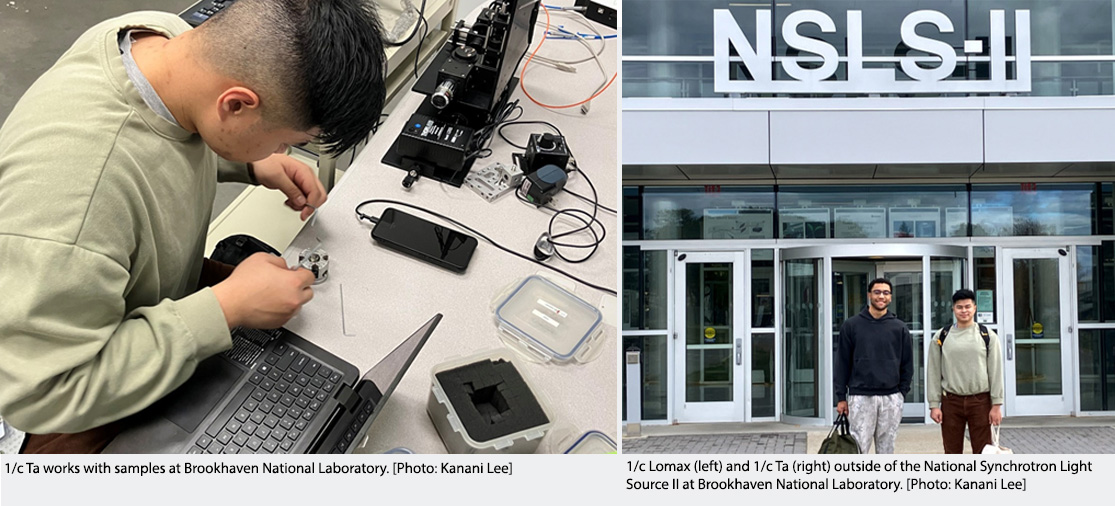
The procedure begins in Lee’s lab located in Smith Hall, where she prepares the samples for experiments. She and her team then travel to Brookhaven National Laboratory on Long Island, New York, where they conduct the high-pressure experiments at extremely small spatial scales. Brookhaven National Laboratory houses state-of-the-art facilities, including the National Synchrotron Light Source II, capable of generating ultrabright, highly stable beams of light.
By subjecting minerals of various composition and crystal structure to high pressures and measuring their optical absorption, Lee elucidates sources of error in previous temperature measurements that, until now, have made estimates of melting temperatures inaccurate. Her measurements, coupled with thermal modeling, yields a correction factor that scientists can use to make more accurate measurements, helping them better understand processes involved in planet formation and evolution, including those leading to the formation of the ocean and atmosphere.
Lee’s project also represents outstanding opportunities for cadet capstone projects and independent research. This year, 1/c Nahn Ta and 1/c Jayden Lomax accompanied her to Brookhaven National Laboratory to collect data for their projects. “Undergraduate research is key to a rigorous science education and greatly enhances the skill set of our future leaders,” says Lee. “In these experiments, we start with a hypothesis based on current understanding and uncertainties from the scientific literature. We then test assumptions and either validate or pivot from those ideas. We look for trends and determine the reasons behind patterns that we measure, testing existing theories. Finally, we apply the results to the things we care about. The ability to critically think, analyze data, and apply results are important skills to cultivate in future Coast Guard leaders.”
The National Science Foundation grant provides Lee with four years of research support. This summer, the project enters its second year. In addition to sharing findings in journal publications, results from this study will be broadly disseminated through community tutorials, seminars, and conferences. The grant also supports post-doctoral researcher, Dr. Matthew Diamond, who brings to the project expertise in both high-pressure experiments and software toolkit development.