Biological research at the Coast Guard Academy received a major boost this year thanks to the National Science Foundation (NSF), which awarded a grant to a multi-institutional team of faculty working to further undergraduate education in the fields of toxicology, biochemistry, and related fields.
Led by Dr. Joshua Gray, Department of Chemical and Environmental Sciences, the team of six faculty investigators secured nearly $400,000 to design, develop, incorporate, and assess teaching materials that help faculty integrate authentic research experiences into undergraduate science courses. Co-investigators include faculty from Washington College (Maryland), Lincoln Memorial University (Tennessee), Husson University (Maine), the University of Maine, and the Medical University of South Carolina.
Gray’s approach leverages the nationally recognized Course-based Undergraduate Research Experience (CURE) methodology, which involves students conducting original research with faculty mentors in the context of traditional biology courses. To support this work, the faculty team will develop several laboratory modules focused on understanding biological stress in Caenorhabditis elegans (C. elegans), a free-living transparent nematode (roundworm) about 1 mm in length.
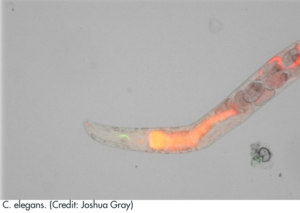
The worm is relatively easy to care for in the laboratory, making it a convenient organism for students to work with while learning to carry out scientific research. It also serves as a model system for scientists seeking to understand how stress can affect an organism’s ability to survive, grow, and reproduce. Biological stress includes any disturbance to the resting state of an organism by any internal or environmental factor, such as a chemical, light, food, or even genetic differences. It is something all living organisms experience, so understanding it is a subject of universal interest to scientists. It also features prominently in the name of the project: StressCURE.
Over the next three years, the investigators will develop laboratory modules focusing on techniques that undergraduate students from the six collaborating institutions will use to learn to develop hypotheses, carry out laboratory experiments, analyze data, and draw conclusions based on their results. Gray and the team will use these opportunities to develop and test new teaching modules that help other faculty members build laboratory courses that promote authentic undergraduate research experiences using C. elegans.
Although the modules have direct connections to subjects often taught in general biology, molecular biology, biochemistry, and neuroscience courses, Gray emphasizes that the research skills students learn are transferable to virtually any discipline and are vital to a robust undergraduate STEM education. “Peer reviewed research shows that students exposed to research early in their education have higher retention in science,” he says. “They perform better academically, are more resilient to failure, and develop a stronger sense of scientific identity.”
In the first eight months of the study, the team has already produced eight self-contained teaching modules that are publicly available through the study’s website, stresscure.org. Some topics include Basic Worm Picking, Recipes for C. elegans Culturing, Basal Slowing Response, and Aversion Assay. The goal is to produce at least twenty-two more.
Funding from NSF over the three-year study will also be used to purchase laboratory supplies, host collaborator workshops, present findings at professional conferences, and publish in peer-reviewed journals. In addition, the team hired a program evaluator to assist in determining how successful the teaching modules are in helping students achieve established learning outcomes.
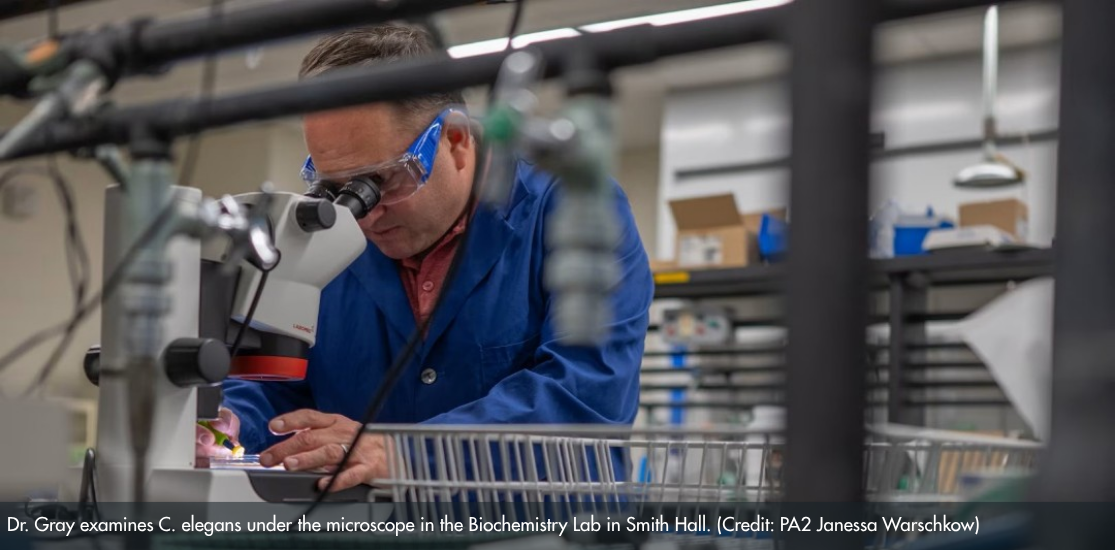 Gray and colleagues have presented their work at the 2025 Society of Toxicology meeting in Orlando, Florida. Asked about highlights of the experience so far, Gray is quick to say that, besides working with students, the best part is “knowledge sharing” — the opportunity to develop teaching materials with colleagues who are passionate about undergraduate research and to share the modules with other interested faculty.
Learn more at stresscure.org