The Coast Guard Academy is proud to celebrate 1/c Elise Beauchemin’s selection for a prestigious Fulbright Scholarship through the Fulbright U.S. Student Program. In August 2025, Beauchemin began classes at The Arctic University of Norway (UiT) in Tromsø, where she is studying Arctic Marine Ecology.
Beauchemin is eager to begin the next chapter. “It’s a huge honor for me,” she said after learning of her selection. “I’m so excited for what the future holds.” She expressed deep gratitude for the support she received from the Coast Guard Academy’s Center for Arctic Study and Policy. CAPT (ret) Anthony Russell and Dr. Abbie Tingstad helped to shape her interests and provided invaluable mentorship. She also thanked the dedicated team of faculty, especially Dr. Karen Wink, Director of the Prestigious Scholar Program, who provided Beauchemin with guidance through every step of the rigorous application process — from crafting proposals and essays to preparing for interviews, securing recommendation letters, and identifying a thesis advisor at the host university.
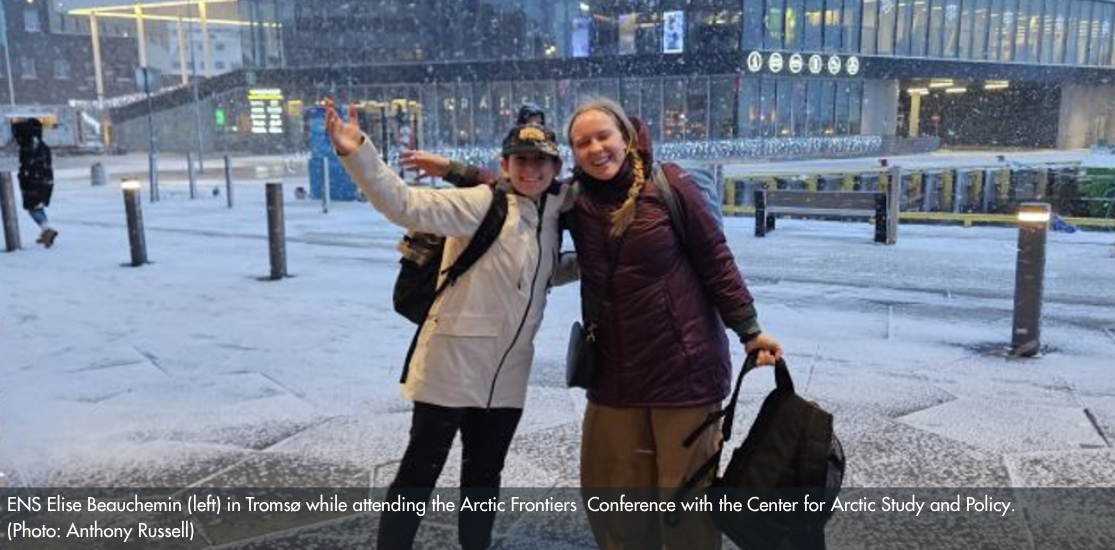
With that process behind her, Beauchemin is looking forward to taking courses and conducting research. Some of her courses will include Arctic System Ecology and Study Design and Data Analysis in Biology, with electives in Food Webs and Fisheries, Arctic Marine Pollution, and Sea Ice Habitats and Biology.
For research, Beauchemin will investigate the potential effects of underwater vessel noise on white whales (Delphinapterus leucas), also known as beluga whales, and on other migratory whales. Alongside scientists at the Norwegian Polar Institute, she will conduct field work in Isfjorden, a fjord in western Norway that is vital habitat for migrating whales and heavily used for maritime commerce.
The team plans to use drones to carefully deploy minimally invasive cameras and sensors on whales to track changes in their behavior and physiology in the presence of vessel traffic. Beauchemin’s findings will provide critical data for authorities evaluating ways to mitigate disturbance to whales by establishing safe vessel approach distances, speed regulations, or traffic lanes.
In addition to learning about science, Beauchemin is excited to experience the culture of Norway. She has begun to learn some Norwegian phrases to, in her words, “experience the joy of shared cultural understanding provided by the Fulbright Program.”
She is also eager to expand her perspectives on the Arctic region in ways that benefit the Coast Guard. “There is so much to learn from Norway’s leadership in Arctic marine system ecology [that can help us] understand ecological stress from human impacts.” After completing her graduate studies, Beauchemin will be stationed in Sitka, Alaska, where she plans to continue to focus on environmental protection and Arctic missions.
First on the agenda, however, is a flight to Oslo in August, then two weeks of field work in Svalbard, Norway, one of the world’s northernmost settlements. Svalbard is also a location where white whales spend a significant amount of time near glacier fronts, which are areas where ice at the leading edge of a glacier meets ocean water. It is hard to imagine a more fitting place for Beauchemin to begin her own Arctic voyage.