The Mathematics Department made significant progress this year in incorporating Artificial Intelligence (AI) into research, teaching, and learning at the Coast Guard Academy. Buoyed in part by funding from the National Security Agency, the faculty undertook projects ranging from collaborative research on image denoising using deep learning techniques to using generative AI (GenAI) in the multicalculus classroom, further exploring its potential for higher education.
Deep learning for image denoising
On the research side, Dr. Arundhati Bagchi Misra and her colleague, Dr. Kathy Krystinik, initiated novel work into AI-assisted digital image denoising. They are developing a better technique for extracting useful information from images made unclear by pixel imperfections caused by interference from glare, motion, or dropped signals at the time a picture is taken.
Image denoising has many real-world applications, since it makes objects in an image easier to decipher. For example, anyone who has seen a medical ultrasound image can appreciate how removing background noise could produce a clearer image. Image denoising is also used to clarify objects in satellite imagery to, for example, assess the scope of local damage following a natural disaster.
How does an AI-assisted approach to image denoising differ from traditional methods? Traditional image denoising uses partial differential equations (pde) and filtering-based models. The former uses complex equations and iterative calculations to assign new color values to problematic pixels, which tends to smooth out the image and create a blurring effect. The latter method updates the noisy pixels based on the color value of surrounding pixels.
Bagchi Misra has used traditional methods in the past, but recent conversations with Krystinik inspired her to try a different approach, one that employs a machine learning technique called deep learning. The technique involves training a computer model to recognize pixels that contribute to visual noise in an image. Bagchi Misra and Krystinik start with multiple copies of a single clean image and add artificial noise (pixels) to some, creating a training and testing data set. Next, they use Neural Network models to “teach” the computer which pixels were problematic, allowing the model to “learn” the characteristics of clean images. Once the model is trained, Bagchi Misra and Krystinik provide it with clean and noisy images, and the model minimizes the error function between both images. The result is a crystal-clear image…at least in theory.
This year, Bagchi Misra focused on testing the performance of different image denoising models on black-and-white photographs. First, she introduced a random distribution of noisy pixels to an otherwise clear image, making that image unclear (noisy). She then applied two image denoising models in Python programming language, each based on deep-learning models: Artificial Neural Network (ANN) and Convolutional Neural Network (CNN). She then ran each model on the noisy image and compared how well each returned the image to its original clarity, an option not usually available in real-world applications. Model performance was also compared to that of traditional denoising models.
The results have been surprising.
Typically, denoising makes images easier to interpret, but results from the ANN model were almost too good to believe. It produced an image that, to the human eye, was remarkably similar to the original noise-free image. The CNN model performed as expected, improving the noisy image, but still leaving it blurrier than the original, clean photograph.
“We are trying to figure out why that would be,” says Bagchi Misra. Once the results are understood, she plans to move on to color images, which pose a greater challenge to researchers. Unlike grayscale images, which use a one-dimensional linear scale of 255 shades of gray to depict an object, color images use a three-dimensional scale of red, blue, and green layers, each with a separate shade scale. This situation calls for a model accounting for more complex, layered computations among the three color channels.
Denoising color images would expand the range of applications for Bagchi Misra’s findings. She also looks forward to expanding the project by bringing cadets onboard. “Eventually,” she says, “we will include cadets, a couple years down the road, once we have the techniques more worked out.”
Bagchi Misra was awarded a Faculty Research Forum Fellowship during Summers 2024 and 2025 to work on this study, and in April, presented her initial findings at the American Mathematical Society meeting in Hartford, CT and at the Military Operations Research Society Symposium in Leesburg, VA.
Generative AI in the Classroom
Also this year, Mathematics instructor LCDR Justin Sherman brought generative AI into the calculus classroom. Driven to equip future Coast Guard officers to work with data in general — and with generative AI (GenAI) in particular — Sherman and his colleagues developed two new data-centric, project-based lesson plans for students in Multivariate Calculus, lesson plans that include metrics for measuring student success in mastering the techniques.
The first student project took a manual approach to calculus education. Students worked with multidimensional data while learning about partial derivatives. They used a provided dataset to calculate and graph decision boundaries — linear or non-linear surfaces separating two or more classes of data plotted on a two- or three-dimensional axis.
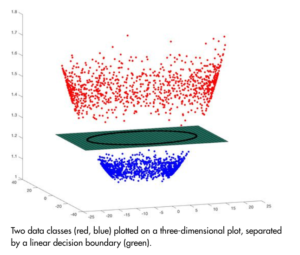
In the second project, students were asked to use a GenAI model of their choice to perform the same calculation as in the first project and to produce a visual image of the plot. Most chose to use ChatGPT, but some used Gemini or a similar model. Students were asked to evaluate how AI performed in comparison to their own calculations performed in the previous project.
While many found that ChatGPT produced decision boundaries very similar to their own, some found the results to be quite different. Instead of curved surfaces separating two groups of data, the GenAI model calculated either a straight-line boundary or a boundary that didn’t clearly separate the two data classes. In some cases, it produced an overly elaborate graph.
Reflecting on their experience, some students said they learned to ask better questions of ChatGPT and adjusted their guidance over the course of the hour to achieve better output. Some said ChatGPT was “a great partner,” while others expressed disappointment in the quality of the output, noting that if they hadn’t performed their own calculations first, they wouldn’t know how much better the GenAI model output should be.
Sherman’s hope is that exercises like these strengthen students’ mathematical understanding of topics taught in class. He also believes it will help students appreciate the benefits and limits of GenAI tools and set “reasonable boundaries to how we use these tools.”
Sherman presented this work at a Faculty Research Forum Lunchtime Seminar in the Spring. He also plans to submit a paper to a peer-reviewed journal published by the Mathematical Association of America.
Looking ahead
The Mathematics Department sees these experiences as initiating a broader integration of AI theory and techniques into the curriculum at the Coast Guard Academy so that graduates will be ready to work in a world transformed by AI technology.
Faculty are also developing a framework for additional curriculum development in the field of data and GenAI literacy. The framework, referred to as the Data and Artificial Insight Initiative, or DAI3, includes a suite of courses in which students explore effective, ethical, and responsible techniques for data analytics and problem solving with GenAI. The team will identify metrics for assessing student learning in these realms and craft assignments that help students implement their knowledge of AI in support of Coast Guard missions and public service.
Mathematics Department Head, Dr. Jillian McLeod, says “The ORDA curriculum is a natural environment for impactful inquiry and exploration with intelligence models. Through these initiatives, our faculty and cadets bring the USCGA into dialogue with the rest of higher education.”