CASP Staff
Dr. Abbie Tingstad
- Icebreakers are niche vessels, but security, diplomatic value is high, Abbie Tingstad, Jul 28, 2024.
- The U.S. is Taking an Important, but Imperfect Step in Initiating Extended Continental Shelf Claims – What Are the Implications for the Arctic?, Abbie Tingstad, Dec. 19, 2023
- The U.S. Military Needs to Build Arctic Capabilities and Capacity, Abbie Tingstad and Scott Savitz. Note, this study was completed prior to Dr. Tingstad’s joining CASP, Dec. 22, 2023
- Being an Arctic Nation is for the Good of All Americans, Abbie Tingstad, Nov. 22, 2023
Dr. Rebecca Pincus (Former Class of ’65 Arctic Scholar)
- “The Unique Dual-Nature Aspect of Search and Rescue Enables Competing Frames: Russia, the USA, and the Cruise Industry,” Rebecca Pincus and Michele Zebich-Knos
- “Have You Been to ‘The Arctic’? Frame Theory and the Role of Media Coverage in Shaping Arctic Discourse,” Dr. Rebecca Pincus and Saleem H. Ali
- “Diplomacy on Ice; Energy and the Environment in the Arctic and Antarctic,” Edited by Dr. Rebecca Pincus and Saleem H. Ali
Dr. Barry Zellen (Former Class of ’65 Arctic Scholar)
- “Stepping-Stones to a Secure Arctic: Strategic Importance of Arctic Island Chains Grows in Lockstep with Rise in Polar Temperatures, State Rivalry,” CG Proceedings (The Coast Guard Journal of Safety and Security at Sea: Proceedings of the Marine Safety and Security Council), Volume 78, No. 1 (Spring 2021), 25-30. Dr. Barry Zellen
- “State-Tribe Collaboration and the Future of Arctic Cooperation: Moderating Inter-State Competition through Collaborative Multilevel Governance, from Trading Posts to the Arctic Council,” in the Special Issue on Polar Law of The Polar Journal (Taylor & Francis Group), September 2020. Dr. Barry Zellen
- “Greenland as an American Territory: A Bad Idea, a Bold Idea … or a Beyond-the-Horizon Idea worth Studying?” Dr. Barry Zellen
LCDR Jeremy McKenzie, USCG (ret.), (Former CASP researcher)
- “US Arctic Policy since Nixon: Continuity and Incremental Change,” Jeremy McKenzie, Summer 2023.
- “A Case for a Stronger Partnership with Russia in the Arctic,” Jeremy McKenzie, December 2019.
- “Instead of Buying Greenland, Enhance Security & Cooperation,” Jeremy McKenzie, November 2019.
- “America is an Arctic Nation, It’s Time We Acted Like It,” Jeremy McKenzie, January 2019.
Ms. Lucy Daghir (Former CASP cadet/student)
CASP Fellows
Dr. Craig Allen
- “Closing the Icebreaker Gap (1 of 2),” Professor Craig Allen
- “Closing the Icebreaker Gap (2 of 2),” Professor Craig Allen
- “A Busy March for Arctic Affairs Watchers,” Craig H. Allen
- “The Coast Guard Advances its Arctic Readiness in 2015, but Challenges Remain,” Dr. Craig Allen (previous CMPS faculty, presently CASP Fellow)
- “Will Compulsory Dispute Settlement Sink the LOS Convention in the Senate?,”Dr. Craig Allen (previous CMSP faculty, presently CASP Fellow);
- “The International Law of the Sea: A Treaty for Thee; Customary Law for Me?,”Dr. Craig Allen (previous CMSP faculty, presently CASP Fellow)
Dr. Lawson Brigham
- Agency Challenges and Implications with a U.S. Extended Continental Shelf, Lawson Brigham, Dec. 19, 2023
- “Global Offshore Wind Energy: Emerging Ocean Use”, U.S. Naval Institute Proceedings, January 2021
- “The Suez Canal and Global Trade Routes,” U.S. Naval Institute Proceedings, May 2021
- “Sustainable Shipping in a Changing Arctic,” Dr. Lawson W. Brigham
- “US, Russia can look north to the Arctic to find common ground,” Mike Sfraga and Lawson Brigham
- House Testimony (pdf), Dr. Lawson W. Brigham
- “Arctic Maritime Connections,” Dr. Lawson W. Brigham
- “Charting the U.S. Maritime Arctic,” Dr. Lawson W. Brigham
- “More Assets for the Arctic,” Dr. Lawson W. Brigham
- “Russia and U.S. Must Maintain Arctic Relations in an Interconnected World,” David Slayton, Lawson W. Brigham, Ph.D
Mr. Jim Ellis
VADM Roger Rufe
- “New Coast Guard Measures Mean Safer Shipping in the U.S. Arctic,” VADM Rufe (USCG, ret.)
Additional Contributions
CASP Affiliated Faculty
- Proximity of Commercial Maritime Traffic to the Arctic Marginal Ice Zone, 2012−2023, As presented at the Arctic Frontiers conference, Tromso, Norway, January 31, 2024 by Lucy Vlietstra, U.S. Coast Guard Academy of work done in collaboration with Kayla Hinrichs, Independent Researcher
- Polar class ship accessibility to Arctic seas north of the Bering Strait in a decade of variable sea-ice conditions, Lucy Vlietstra, Kayla R. Hinrichs, E. Rachel Bernstein, Alexandra Darden, Matthew Martino
Cadet Student Research
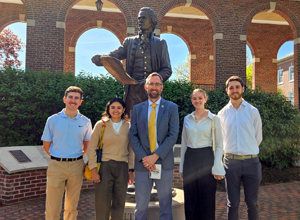 CASP asked Brown University’s Watson Institute for International and Public Affairs graduate students to examine: What political and diplomatic factors have led to successful Antarctic governance since the late 1950s? In 2024, the U.S. pledged to “strengthen its promotion of transparency, compliance, cooperation, the exchange of best practices, and adherence to relevant norms by all ATS participants.” What type(s) of policy or policies could help the U.S. achieve this?
In response, they produced the research paper, “No Time for the Cold Shoulder: How Supporting the Antarctic Treaty System Promotes U.S. National Interests,” and a companion two-page table drop, Antarctic Governance and US Interests.
 A time-dependent ice accretion model for trap-setting fishing vessels with Filigree structures.” A paper presented by cadets Peter MGonagle, Colman Schofiled, and Delaney Taplin-Patterson at the 15th International Marine Design Conference (IMDC-2024), in Amsterdam, the Netherlands, June 2-6, 2024.
READ MORE
 Antarctica is a Long Way from Becoming a Contested Space, the Coast Guard has a Role Ensuring it Doesn’t (Polar Insights 02-24)
Produced at the Center for Arctic Study and Policy by Dr. Abbie Tingstad, with contributions by Dr. Lawson Brigham, Mr. Tony Russell, and Mr. William Muntean, CSIS Senior Associate

A Not-so Ice-free Arctic Ocean: Implications for Coast Guard Operational Capabilities, Posture, and Strategic Messaging (Polar Insights 01-24)
By Dr. Lawson Brigham, Dr. Abbie Tingstad and Mr. Tony Russell
- 2024 DOD Arctic Strategy
- National Strategy for the Arctic Region Implementation Plan (2023)
- U.S. Coast Guard Arctic Strategic Outlook Implementation Plan (2023)
- National Strategy for the Arctic Region (2022)
- U.S. Department of State, Office of the U.S. Coordinator for the Arctic Region
- DHS Strategic Approach for Arctic Homeland Security (2021)
- Department of the Navy Strategic Blueprint for the Arctic (2021)
- U.S. Army Regaining Arctic Dominance (2021)
- Department of the Air Force Arctic Strategy (2020)
- U.S. Coast Guard Arctic Strategic Outlook (2019)
- Department of Defense Arctic Strategy (2019)
- Implementation Plan for the National Strategy for the Arctic Region (2014)
- U.S. in the Arctic Council
- International Maritime Organization (IMO) Polar Code
- Arctic and North Atlantic Security and Emergency Preparedness Network (ARCSAR)