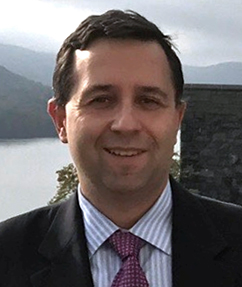
Dr. Edward Canuel is a professor, diplomat, and attorney. He has been a professor at multiple universities (Aalborg, American, West Point, and Aarhus); his teaching and research focus on the Arctic, energy/mining law, infrastructure security, resilience issues, and critical minerals (including deep seabed mining). Ed holds a B.A. from Boston College (summa cum laude); a Juris Doctor from Boston College Law School; a Master of Laws from Osgoode Hall in Business Law (where he served subsequently as an Osgoode Visiting Scholar); and a Ph.D. from the University of Oslo (comparative private law, focusing on the energy and finance sectors).
As a diplomat, Ed most recently served in various roles at the U.S. Mission to International Organizations in Vienna, including as Acting Deputy Chief of Mission, Acting Counselor for International Atomic Energy Agency Affairs, and Deputy Counselor for Nuclear Affairs. Immediately prior, Ed served in the White House as both the Homeland Security Advisor’s Coordinator for Arctic Affairs and Deputy Senior Director in the National Security Council’s Resilience Directorate. Ed’s previous diplomatic tours include serving as Deputy Office Director in the Bureau of Counterterrorism; Senior Advisor in the Office of the Deputy Secretary of State; Environmental/Energy Trade Negotiator; State Department Visiting Professor (the U.S. Military Academy at West Point); Regional Environmental Officer/Acting Deputy Chief of Mission (Copenhagen); Energy and Economic Officer (Oslo); and Treaty Trader Officer (Toronto). In 2012 and 2017, Ed was selected as the U.S. government’s candidate for the Arctic Council Secretariat’s Executive Director position. Prior to joining the State Department, Ed practiced corporate law at an international law firm. He has proficiency in French, Norwegian, Danish, Swedish, and Russian.
Education
- University Of Oslo Law School, Oslo, Norway, Ph.D. in Law, 2009
- Osgoode Hall School Of Law, York University, Toronto, Canada, Master of Laws in Business Law, 2005
- Boston College Law School, Newton, MA, Juris Doctor, 1997
- Boston College, Chestnut Hill, MA, Bachelor of Arts in Philosophy and Political Science, 1993
Courses Taught
- Modern Diplomacy
- Global Energy Landscape
- U.S. Foreign Policy
- Resilience
Selected Publications
Published in national and international peer-reviewed journals, books, and periodicals:
- Article, Critical Minerals and Security: Navigating Deep Seabed Mining and the Arctic (under development).
- Article, Energy and Critical Minerals: Exploring Arctic Security and Resilience (under development).
- Article, The Blue Economy and the Arctic, June 4, 2021, Austrian Polar Research Institute at https://www.polarresearch.at/the-blue-economy-and-the-arctic/
- Article, Navigating the Blue Economy, 45 WILLIAM & MARY ENVT’L LAW & POLICY REVIEW 1 (2020).
- Chapter, Alaska and Offshore Hydrocarbon Extraction: A Legal and Socio-Economic Review in the treatise, “Governance of Arctic Offshore Oil and Gas,” (Routledge, 2017).
- Article, Unraveling Arctic Law: The Aarhus University Inaugural Lecture, The West Point Journal of Social Sciences & Humanities (2016).
- Article, U.S. Arctic Hydrocarbon Extraction, 11 UNIVERSITY OF TEXAS J. OF OIL, GAS, AND ENERGY LAW 301-319 (2016).
- Article, The Four Pillars of Arctic Law, 46 GEORGETOWN J. OF INT’L LAW 764 (2015).
- Article, Objective Pluralism: The Comparative Law Tool, 6 INT’L J. OF PRIV. L. (2013).
- Article, Comparative Commercial Law: Methodologies, Black Letter Law and Law-in-Action in 1 NORDIC J. OF COMM. LAW (2012).
- Chapter, Comparing Exculpatory Clauses under Anglo-American Law in the treatise “Boilerplate Clauses, International Commercial Contracts and the Applicable Law,” (Cambridge University Press, 2011).
- Doctoral Thesis, Analyzing Norwegian and U.S. Contractual Damages Clauses: A Comparative Approach, published with the University of Oslo Faculty of Law (2009), ISSN 1890-2375.
- Article, The Legal and Social Implications of Insolvent Cross-Border Real Estate Developers: Reviewing the U.S. and Canadian Commercial Real Estate Markets, in 40 VANDERBILT JOURNAL OF TRANSNATIONAL LAW 727 (2007).
- Article, U.S.–Canadian Insolvencies: Reviewing Conflicting Legal Mechanisms, posted with the International Insolvency Institute and published in 4 HOFSTRA UNIVERSITY JOURNAL OF INT’L BUSINESS & LAW 1 (2005).
- Article, Supporting Smart Growth Legislation and Audits: An Analysis of U.S. and Canadian Land Planning Theories and Tools, in 13 MICHIGAN ST. JOURNAL OF INT’L LAW. 309 (2005).
- Note, Nationalism, Self-Determination, and Nationalist Movements: The Palestinian and Quebec Drives for Independence, in 20 B.C. INT’L & COMP. L. REV. 85 (1997).
Representative Lectures
Guest lecturer/speaker to diverse audiences, including numerous international non-governmental organizations, think tanks, foreign governments, corporations and universities, including:
- Working Group Chair, “Resilience: Exploring Frontier Security Issues,” at the U.S. Military Academy (West Point)’s International Security Seminar, West
- Discussant, “States, Society, and Security in the 21st Century,” at the U.S. Military Academy (West Point)’s International Security Seminar, West Point, New York (February 2024). Led Working Group, “Learning to Deter: Focus on Governance, Strategy, and Training.”
- Lecturer, “The Convergence: The Blue Economy, the Arctic, and Critical Infrastructure,” at the University of Vienna, Austrian Polar Research Institute, Vienna, Austria (April 2021).
- Lecturer, “U.S. Critical Infrastructure Security and Resilience,” at U.S. Military Academy, Department of Social Sciences, West Point, New York (November 2019).
- Evaluator, “Application of the U.N. Convention on the Law of the Sea to Launches and Return of Space Objects: Gaps and Challenges,” PolSEA Intensive Seminar, Copenhagen, Denmark (April 2019).
- Lecturer, “Energy and the Arctic: Yesterday, Today, and Tomorrow,” Georgetown University, McCourt School of Public Policy, Washington, D.C. (March 2019).
- Lecturer, “The Blue Economy,” Aalborg University Department of Law, Aalborg, Denmark (October 2018).
- Session Chair at the U.S. Military Academy (West Point)’s National Student Conference on U.S. Affairs, West Point, New York (November 2017).
- Panelist, “Arctic Development: Shared Solutions for Shared Challenges,” at Wilson Center’s Kennan Institute, Washington, D.C. (September 2016).
- Presenter, “U.S. Environmental Cooperation Agreements, Free Trade, and International Political Economic Theory,” at U.S. Military Academy, Department of Social Sciences, West Point, New York (March 2016).
- Panelist, “The Arctic Symposium,” and Master’s Project Evaluator, U.S. Naval War College, Newport, Rhode Island (April 2015).
- Lecturer, “Unraveling Arctic Law,” Aarhus University Department of Law, Aarhus, Denmark (June 2014).
- Lecture, “Security and the Arctic,” Aarhus University Department of Law, Aarhus, Denmark (June 2014).
Honors & Awards
- Recipient, multiple State Department Superior and Meritorious Honor Awards; Nominee for the Frank E. Loy International Environmental Diplomacy and Arnold L. Raphel Leadership Awards.
- Participant, the interagency National Security Executive Leadership Seminar and the State Department Intensive Leadership Project program.
Professional Associations
- Associate Member, West Point Association of Graduates
- Member, the Austrian Polar Research Institute
- Member, the Arctic Law Thematic Network