Research Projects
Marine and Environmental Sciences
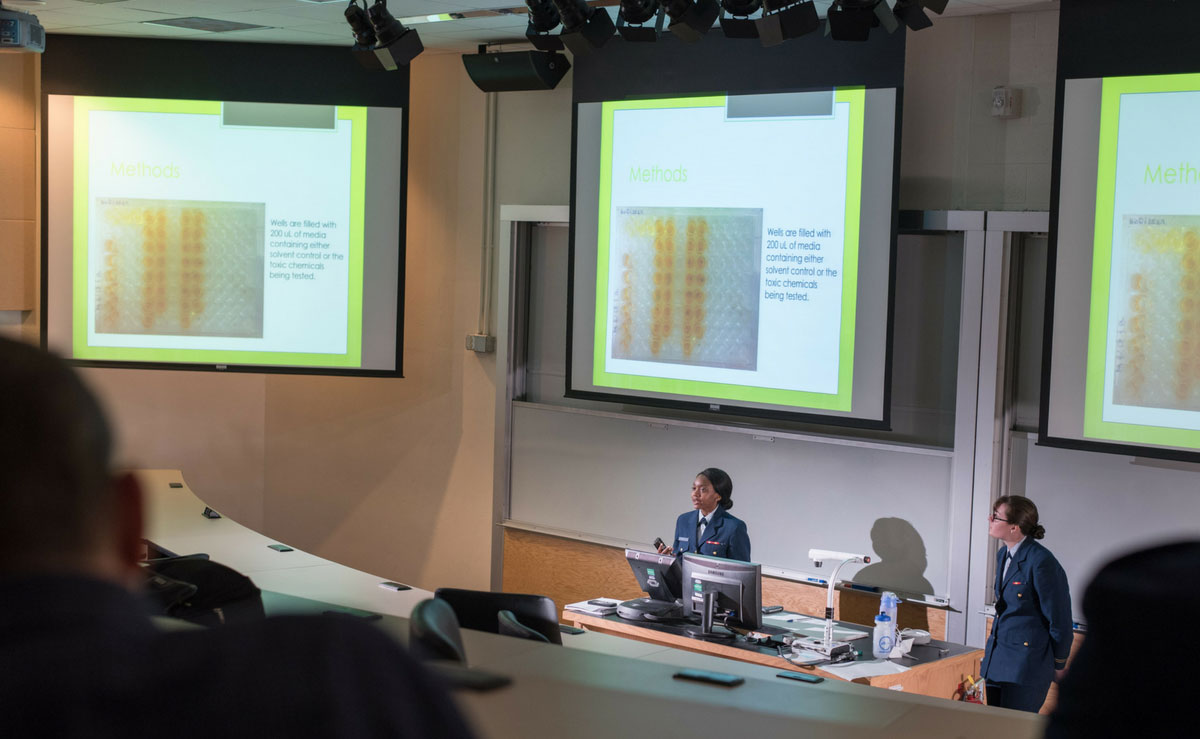
All Marine and Environmental Sciences (MES) cadets participate in faculty-led research projects where they work in small groups in areas of the professor’s expertise as part of a three course capstone series beginning in the spring of 2/c year. Capstone research allows MES students to explore a topic of particular interest in greater depth, while gaining the project-management and problem-solving skills that are key to the scientific method. Cadets write research proposals, carry out the research, and present their work at Cadet Research Day as well as at national conferences.
Independent research is carried out through three courses, starting with a one-credit projects course that prepares students for the three-credit research course. In the projects course, students conduct a thorough literature search, identify the appropriate methodology and then write a research proposal for their three-credit, semester-long research course. The final capstone one-credit course brings their efforts together into a final paper and presentation.
Cadet Research Opportunities
MES majors are able to extend their learning beyond the classroom through a wide range of research opportunities. Recent research studies have included:
Work with LCDR Nielsen to develop a secure, resilient microgrid for Base San Juan, Puerto Rico. Microgrids are designed to operate independently from the main power grid during emergencies disruptions, the microgrid will enhance mission readiness and continuity of operations. This scalable project aims to create a replicable framework for other U.S. Coast Guard installations to strengthen energy assurance and operational security.
Work with Dr. Lee to investigate salty water ice formation at high pressures using a diamond-anvil cell and apply results to planetary bodies and its role in habitability.
Work with Dr. Lee to investigate how various materials change color when pressure and temperature are increased and how that affects temperature measurements.
Work with Dr. Gray and LCDR Schroeder to investigate the effects of micro/nanoplastics and chemical toxicants on the health of the nematode worm, C. elegans. Using a variety of biochemistry and molecular biology techniques, we will determine how microplastics and the chemicals that they carry affect various biochemical pathways within the animal.
Work with Dr. Zingales on medicinal chemistry projects that draw inspiration from natural products to develop new potential drugs. Computational modelling via ligand-based drug design will be used to predict novel structures. Organic synthesis techniques will be used to synthesize, purify, and characterize these compounds. Synthesis method development will be a major component of this project. Once synthesized, these compounds will be tested for their bioactivities.
Work with Dr. Frysinger to investigate the physical (density, viscosity, interfacial tension, distillation) and chemical (gas chromatography, mass spectrometry, fingerprinting, NMR) properties of oils and their fate and transport in the environment. The oil properties dictate where spilled oil goes, Do the oils evaporate, dissolve, disperse, emulsify, biodegrade or chemically degrade.
Work with Dr. Allen, Dr. Selch, and LTJG Farquar on this 2023 USCG RDC Research Portfolio project. Computer components include manipulating pixels in acquired satellite ocean images (e.g., in GIS) and analysis (PCA, classification, etc). Fieldwork components include floating large sheets of various colors on the water and acquiring and analyzing satellite images of the sheets.
Work with Dr. Selch and LCDR Frye to collect imagery using a sUAS and analyzing imagery using ArcGIS Pro. Must like flying drones. Stakeholders include CGHQ/ACoE.
Work with CAPT Futch to study how objects lost at sea are forced by wind and ocean currents. How much each one impacts a search object is unique to the object. This capstone work conducts field tests on previously unstudied search objects, determines their leeway coefficients (how much the wind forces an object compared to the ocean) and that data is then entered into SAROPS for the CG to use during active cases.
Work with Dr. Bergondo and Ms. Lambie to model oil behavior in the environment using the trajectory model OILMAP. Past projects included validating booming strategies outlined in the Geographic Response Strategies (GRS) for CG units. The recent focus has been on the fate and transport of non-conventional oils, including dielectric fluids. This project works with Great Lake Center of Expertise (GLCOE), USCG Marine and Environmental Response, and Tetra Tech/RPS Group (OilMAP).
Work with Dr. Vlietstra and CDR Thompson to map and forecast seabird bycatch “hot spots” by analyzing seabird distribution data, commercial fishing vessel data, and dynamic ocean features in the Bering Sea.
Work with Dr. Bergondo, LTJG Farquar, Mr. Huffman, LCDR Brigham, and Dr. Mrakovcich, in this hands-on, field and lab intensive capstone project seeking to understand the spatial and seasonal species variability in the Thames River, CT. Aspects of the project include deploying & maintaining a YSI water quality buoy, filtering of water for environmental DNA analysis, plankton tows and chlorophyll analysis, beach seining, and bottom trawling.
Although unknown, it is likely that the zonal winds on the gas giants are deep on Jupiter and Saturn and shallow on Uranus and Neptune. Completely different fluid dynamics govern these two paradigms. Recent satellite data constrain an analytic model created by Dr. Allen and may allow us to match the data. This project consists entirely of computer work. No prior experience or knowledge required.